Measurements you need
Tape horizontally across the most prominent points of the bust, at the back — slightly above the shoulder blades, under the arms. In your usual underwear, not pulled tight.Tape horizontally across the most prominent points of the bust, at the back — slightly above the shoulder blades, under the arms. In your usual underwear, not pulled tight.
Usually 31½–51⅛ in.Usually 80–130 cm.Tape horizontal around the fullest part of your buttocks, allowing for the curve of your stomach. Stand straight, feet together.Tape horizontal around the fullest part of your buttocks, allowing for the curve of your stomach. Stand straight, feet together.
Usually 33⅛–51⅛ in.Usually 84–130 cm.Tilt your head: a prominent vertebra can be felt at the base of the neck at the back. Tape from it down along the spine to the waist tape.Tilt your head: a prominent vertebra can be felt at the base of the neck at the back. Tape from it down along the spine to the waist tape.
Usually 14⅝–17⅜ in.Usually 37–44 cm.At the side from the waistline down to the desired hem. For a knee-length skirt — about 23⅝ in, for pants — to the floor or to the ankle bone.At the side from the waistline down to the desired hem. For a knee-length skirt — about 60 cm, for pants — to the floor or to the ankle bone.
Skirt 15¾–39⅜ in, pants 35⅜–43¼ in, shorts 11¾–21⅝ in.Skirt 40–100 cm, pants 90–110 cm, shorts 30–55 cm.Which ease to choose
| Garment | Bust ease | Armhole depth ease |
|---|---|---|
| Knit T-shirt | +2⅜–3⅛ in6–8 cm | +¾ in2 cm |
| Sweatshirt | +3⅞–5½ in10–14 cm | +1⅝ in4 cm |
| Hoodie, oversized | +6¼–9½ in16–24 cm | +2–2⅜ in5–6 cm |
| Loose blouse | +3⅞ in10 cm | +1⅛ in3 cm |
How the block is drafted
The front and back are the same width — a quarter of the bust plus ease — with straight side seams; if the hips are wider than the bust, the hem widens toward the hips. There are no darts. The shoulder is dropped: the more bust ease you add, the further the shoulder end extends past the shoulder bone — on a loose garment this helps the armhole and sleeve sit better. Armhole depth is measured from the prominent vertebra around the bust plus ease. At the shoulder the front sits ⅜ in1 cm lower than the back: without a bust dart this keeps the garment from riding up at the back.
The pattern maker checks the draft itself: bust circumference around the outline, matching side seams, back shoulder fit, neckline clearance, and length and width at the hem. Results appear in the "Draft check" section.
Sleeve and hood
Draft the block, then go to the "Sleeve" tab: the pattern maker takes the armhole of this block and makes a lower sleeve cap — for the dropped shoulder. On the "Hood" tab, the hood neckline is taken from this block's neckline.
How to print and tape
Download the PDF on Letter or A4 sheets and print at 100% scale, without "fit to page". The first sheet has the test square: measure it with a ruler. Sheets are taped with an overlap along the ⅜ in1 cm strips; page numbers and the assembly diagram are on the first page. For a copy shop or plotter, choose "One-sheet PDF".
What you get
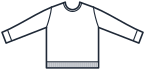
The sweatshirt front and back on the fold at full size: armhole notches for the sleeve and at the waistline, grainline, seam allowance and hem allowance. Below the drawing — the armhole length for the sleeve.
FAQ
What length should I choose?
Length is measured down the back from the prominent vertebra at the base of the neck. A classic sweatshirt hits mid-hip, about 24⅜–26 in62–66 cm; a cropped one is 19⅝–21⅝ in50–55 cm. If the hem will be on a cuff, subtract the cuff width.
How do a T-shirt, sweatshirt and hoodie differ?
They're one block with different ease: a T-shirt has 2⅜–3⅛ in6–8 cm bust ease, a sweatshirt 10–14, a hoodie 16 and more. The more ease, the looser the garment and the more the shoulder is dropped. Choose the garment in the "What are you sewing" field — the ease fills in automatically and you can adjust it.
Do I need shoulder width?
Not necessarily: if you leave it at 0, the pattern maker estimates it from your bust. But with the measurement — across the back from one shoulder bone to the other — the shoulder will fit more precisely.
Is this block suitable for jackets and blouses?
Yes, a dartless block works for loose blouses, bombers, windbreakers and jackets. For outerwear, increase the bust ease to 5½–7⅞ in14–20 cm and the armhole depth ease to 2–2⅜ in5–6 cm so there's room for layers underneath.