Measurements you need
Tape horizontally across the most prominent points of the bust, at the back — slightly above the shoulder blades, under the arms. In your usual underwear, not pulled tight.Tape horizontally across the most prominent points of the bust, at the back — slightly above the shoulder blades, under the arms. In your usual underwear, not pulled tight.
Usually 31½–51⅛ in.Usually 80–130 cm.Tape around the base of the neck: at the back across the prominent vertebra, in front — above the hollow between the collarbones. You can leave 0 — we'll calculate from the bust.Tape around the base of the neck: at the back across the prominent vertebra, in front — above the hollow between the collarbones. You can leave 0 — we'll calculate from the bust.
Usually 13⅜–16½ in.Usually 34–42 cm.Tape horizontal around the fullest part of your buttocks, allowing for the curve of your stomach. Stand straight, feet together.Tape horizontal around the fullest part of your buttocks, allowing for the curve of your stomach. Stand straight, feet together.
Usually 33⅛–51⅛ in.Usually 84–130 cm.Tilt your head: a prominent vertebra can be felt at the base of the neck at the back. Tape from it down along the spine to the waist tape.Tilt your head: a prominent vertebra can be felt at the base of the neck at the back. Tape from it down along the spine to the waist tape.
Usually 14⅝–17⅜ in.Usually 37–44 cm.At the side from the waistline down to the desired hem. For a knee-length skirt — about 23⅝ in, for pants — to the floor or to the ankle bone.At the side from the waistline down to the desired hem. For a knee-length skirt — about 60 cm, for pants — to the floor or to the ankle bone.
Skirt 15¾–39⅜ in, pants 35⅜–43¼ in, shorts 11¾–21⅝ in.Skirt 40–100 cm, pants 90–110 cm, shorts 30–55 cm.Bend your arm slightly at the elbow. From the end of the shoulder (shoulder bone) along the outside of the arm through the elbow to the desired length: for a long sleeve, to the wrist bone.Bend your arm slightly at the elbow. From the end of the shoulder (shoulder bone) along the outside of the arm through the elbow to the desired length: for a long sleeve, to the wrist bone.
Long 22–24⅜ in, three-quarter 16½–18⅞ in, short 8⅝–11 in. For children, long is about 0.29 of height.Long 56–62 cm, three-quarter 42–48 cm, short 22–28 cm. For children, long is about 0.29 of height.Tape around the wrist over the protruding bone, loose, not tight. The cuff is drafted from it: add 2¾ in ease and ¾ in for the closure.Tape around the wrist over the protruding bone, loose, not tight. The cuff is drafted from it: add 7 cm ease and 2 cm for the closure.
For men, usually 6¼–7⅞ in.For men, usually 16–20 cm.How the shirt is drafted
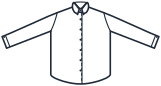
The base is our men's bodice without darts, with ease added for shirting fabric: classic fit — 9 in23 cm at the bust with a back pleat, slim fit — 6¼ in16 cm and darts, relaxed fit — 11¾ in30 cm. The armhole is deeper than on a knit: from the prominent vertebra to its bottom is 0.1 of the bust plus 6⅞ in17.6 cm. The yoke extends onto the front by 1 in2.5 cm — there is no shoulder seam, as on classic shirts. The front is longer than the back at the center, with a curved hem. The collar stand follows the neckline exactly plus the closure, and the collar follows the top of the stand. The sleeve has a high sleeve cap (0.24 of the armhole length), two pleats and a vent with a facing at the cuff.
We checked the draft against proven commercial patterns of the same style: the main measurements match.
The pattern maker checks the draft itself: bust, matching side seams, that the armhole and yoke haven't changed and the yoke meets the front, the collar stand along the neckline, the collar along the stand, the sleeve cap along the armhole and the sleeve hem along the cuff. The results are in the "Draft check" section.
How to print and tape
Download the PDF on Letter or A4 sheets and print at 100% scale, without "fit to page". The first sheet has the test square: measure it with a ruler. Sheets are taped with an overlap along the ⅜ in1 cm strips; sheet numbers and the assembly diagram are on the first page. For a copy shop or plotter, choose "One-sheet PDF".
What you get
The yoke, back, front with a facing and button markings, sleeve with vent and pleats, collar stand, collar, cuff and vent facing — full size, with seam allowances.
FAQ
Which fit should I choose?
Classic — a relaxed shirt with a back pleat, 9 in23 cm wider at the bust than the body. Slim — 2¾ in7 cm narrower, no pleat, with back darts and sides tapered to the waist. Relaxed — oversized, 11¾ in30 cm wider at the bust.
What is the collar size?
It's the neck circumference at the base, as on a ready-made shirt label: 39, 40, 41. If you're between sizes, go up. The neckline and collar stand are drafted from it; the stand closure is calculated so a finger fits under the collar.
How do I measure sleeve length?
Arm down: from the end of the shoulder (shoulder bone) to the wrist bone. The pattern maker subtracts the cuff and adds ¾ in2 cm for ease so the sleeve isn't short when you bend your arm.
What fabric should I use?
Shirting cotton: poplin, oxford, chambray, linen, lightweight denim, flannel for a warm shirt. Interface the collar stand, collar and cuffs with fusible interfacing.