Measurements you need
Tape horizontally across the most prominent points of the bust, at the back — slightly above the shoulder blades, under the arms. In your usual underwear, not pulled tight.Tape horizontally across the most prominent points of the bust, at the back — slightly above the shoulder blades, under the arms. In your usual underwear, not pulled tight.
Usually 31½–51⅛ in.Usually 80–130 cm.Tape horizontal around the narrowest part of your torso, usually ¾–1⅝ in above the navel. Snug but not tight; don't pull in your stomach.Tape horizontal around the narrowest part of your torso, usually 2–4 cm above the navel. Snug but not tight; don't pull in your stomach.
Usually 22⅞–43¼ in.Usually 58–110 cm.Tape horizontal around the fullest part of your buttocks, allowing for the curve of your stomach. Stand straight, feet together.Tape horizontal around the fullest part of your buttocks, allowing for the curve of your stomach. Stand straight, feet together.
Usually 33⅛–51⅛ in.Usually 84–130 cm.At the side, from the waistline down to the level where you measured the hip. It helps to tie a ribbon at the waist and measure from it.At the side, from the waistline down to the level where you measured the hip. It helps to tie a ribbon at the waist and measure from it.
Usually 7⅛–8⅝ in.Usually 18–22 cm.Sit on a hard chair. At the side, straight down from the waistline to the seat. This measurement determines whether the pants will pull or hang loose at the crotch.Sit on a hard chair. At the side, straight down from the waistline to the seat. This measurement determines whether the pants will pull or hang loose at the crotch.
Usually 9½–11¾ in.Usually 24–30 cm.Tilt your head: a prominent vertebra can be felt at the base of the neck at the back. Tape from it down along the spine to the waist tape.Tilt your head: a prominent vertebra can be felt at the base of the neck at the back. Tape from it down along the spine to the waist tape.
Usually 14⅝–17⅜ in.Usually 37–44 cm.How the kids' pajamas are drafted
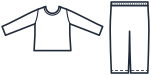
The top is a kids' bodice with no darts, the same as the kids' T-shirt and sweatshirt: the neckline is wider than an adult's so the head goes through, the shoulder is barely dropped, and the sleeve cap is low and shorter than the armhole by ⅝ in1.5 cm. Sleeve length and hem width are based on height: long sleeves reach the wrist with some room, short sleeves are about 0.1 of height. The pants and shorts are our kids' elastic-waist pants and shorts, with hip ease of 3⅞ in10 cm and a crotch depth that is deeper by ⅜ in1 cm.
We checked the draft against proven commercial patterns for the same style: the main measurements match.
The pattern maker checks every part itself: bust and shoulder seams of the top, sleeve cap and armhole, and the circumferences and seams of the pants. The results are in the “Draft check” section.
How to print and tape
Download the PDF on Letter or A4 sheets and print at 100% scale, without “fit to page.” The first sheet has the test square: measure it with a ruler. Sheets are taped together with an overlap along the strips ⅜ in1 cm; sheet numbers and the assembly diagram are on the first page. For a copy shop or plotter, choose “One-sheet PDF.”
What you get
Front and back of the top, sleeve, front and back of the pants or shorts, and casing — full size, with seam and hem allowances.
FAQ
How loose will the pajamas be?
The top is wider than the bust by 3⅞ in10 cm, like a kids' sweatshirt. The pants and shorts are loose: hip ease 3⅞ in10 cm, crotch depth deeper by ⅜ in1 cm. That way the pajamas don't restrict movement during sleep and are easy to put on.
What fabric should I use?
Top — knit fabric: jersey, interlock, French terry for warm pajamas. The kids' neckline is wider than an adult's, but it's still finished with knit binding — the head won't go through fabric that doesn't stretch. Pants and shorts — knit, flannel, or cotton.
Can I sew just the top or just the pants?
Yes: print only the pieces you need. Separate pages are available for the kids' T-shirt, kids' pants, and shorts.