Measurements you need
Tape horizontally across the most prominent points of the bust, at the back — slightly above the shoulder blades, under the arms. In your usual underwear, not pulled tight.Tape horizontally across the most prominent points of the bust, at the back — slightly above the shoulder blades, under the arms. In your usual underwear, not pulled tight.
Usually 31½–51⅛ in.Usually 80–130 cm.Tape horizontally under the arms, in front — above the bust, at the back — across the shoulder blades. The difference from the bust shows how much the bust projects: the bust dart depends on it. You can leave 0 — we'll calculate for an average bust.Tape horizontally under the arms, in front — above the bust, at the back — across the shoulder blades. The difference from the bust shows how much the bust projects: the bust dart depends on it. You can leave 0 — we'll calculate for an average bust.
Usually 1⅛–3⅛ in less than the bust.Usually 3–8 cm less than the bust.Tape horizontal around the narrowest part of your torso, usually ¾–1⅝ in above the navel. Snug but not tight; don't pull in your stomach.Tape horizontal around the narrowest part of your torso, usually 2–4 cm above the navel. Snug but not tight; don't pull in your stomach.
Usually 22⅞–43¼ in.Usually 58–110 cm.Tape horizontal around the fullest part of your buttocks, allowing for the curve of your stomach. Stand straight, feet together.Tape horizontal around the fullest part of your buttocks, allowing for the curve of your stomach. Stand straight, feet together.
Usually 33⅛–51⅛ in.Usually 84–130 cm.Tilt your head: a prominent vertebra can be felt at the base of the neck at the back. Tape from it down along the spine to the waist tape.Tilt your head: a prominent vertebra can be felt at the base of the neck at the back. Tape from it down along the spine to the waist tape.
Usually 14⅝–17⅜ in.Usually 37–44 cm.At the side from the waistline down to the desired hem. For a knee-length skirt — about 23⅝ in, for pants — to the floor or to the ankle bone.At the side from the waistline down to the desired hem. For a knee-length skirt — about 60 cm, for pants — to the floor or to the ankle bone.
Skirt 15¾–39⅜ in, pants 35⅜–43¼ in, shorts 11¾–21⅝ in.Skirt 40–100 cm, pants 90–110 cm, shorts 30–55 cm.How the pinafore is drafted
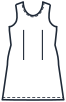
It's built on a dress sloper: the same grid, a bust dart from the side seam, waist darts and a center back seam with waist shaping. We checked the sloper against standard body measurements tables. For the pinafore the shoulder is shortened — giving straps 2⅜–3½ in6–9 cm wide — and the neckline is widened at the shoulder and lowered: at the front to 2¾–3½ in7–9 cm above the bottom of the armhole, at the back 1⅛ in3 cm below the sloper. On the pinafore worn over a blouse the armhole is lowered by 1 in2.5 cm, on the summer version by ⅜ in1 cm.
The pattern maker checks the draft for you: bust, waist and hip, darts, side and shoulder seams, strap and hem width, and the distance from the neckline to the armhole. Results appear in the "Draft check" section.
How to print and tape
Download the PDF on Letter or A4 sheets and print at 100%, without "fit to page". The first sheet has the test square: measure it with a ruler. Sheets are taped with an overlap along the ⅜ in1 cm strips; sheet numbers and the assembly diagram are on the first page. For a copy shop or plotter, choose "One-sheet PDF".
What you get
A front on the fold and two back halves at full size, with seam allowances and hem allowance, plus darts and waist and hip notches.
FAQ
How is the summer pinafore different from the pinafore worn over a blouse?
The summer one is worn on the body: bust ease 2 in5 cm, the armhole almost like a dress, wider straps, a deeper neckline. The pinafore over a blouse or turtleneck is looser by 1⅛ in3 cm at the bust, with the armhole 1 in2.5 cm lower — so the blouse sleeve doesn't bunch.
Which silhouette should I choose?
Straight — like the dress sloper, with a little ease at the hip. The A-line flares from the hip line: 2 in5 cm at each side seam gives freedom when walking, 10–12 each side gives a noticeably flared hem. The hem angle at the side seam is raised slightly so the hem hangs level.
What fabric should I use?
For summer — cotton, linen, rayon, chambray, denim. For the pinafore over a blouse — suiting wool, tweed, corduroy, heavier knit fabric. The neckline and armholes are finished with facings or a lining.
How do I sew it?
Press the darts, sew the center back seam up to the zipper and insert an invisible zipper. Sew the shoulder and side seams. Finish the neckline and armholes with facings or a lining, and hem the bottom.