Measurements you need
Tape horizontal around the narrowest part of your torso, usually ¾–1⅝ in above the navel. Snug but not tight; don't pull in your stomach.Tape horizontal around the narrowest part of your torso, usually 2–4 cm above the navel. Snug but not tight; don't pull in your stomach.
Usually 22⅞–43¼ in.Usually 58–110 cm.Tape horizontal around the fullest part of your buttocks, allowing for the curve of your stomach. Stand straight, feet together.Tape horizontal around the fullest part of your buttocks, allowing for the curve of your stomach. Stand straight, feet together.
Usually 33⅛–51⅛ in.Usually 84–130 cm.At the side, from the waistline down to the level where you measured the hip. It helps to tie a ribbon at the waist and measure from it.At the side, from the waistline down to the level where you measured the hip. It helps to tie a ribbon at the waist and measure from it.
Usually 7⅛–8⅝ in.Usually 18–22 cm.Sit on a hard chair. At the side, straight down from the waistline to the seat. This measurement determines whether the pants will pull or hang loose at the crotch.Sit on a hard chair. At the side, straight down from the waistline to the seat. This measurement determines whether the pants will pull or hang loose at the crotch.
Usually 9½–11¾ in.Usually 24–30 cm.At the side from the waistline down to the desired hem. For a knee-length skirt — about 23⅝ in, for pants — to the floor or to the ankle bone.At the side from the waistline down to the desired hem. For a knee-length skirt — about 60 cm, for pants — to the floor or to the ankle bone.
Skirt 15¾–39⅜ in, pants 35⅜–43¼ in, shorts 11¾–21⅝ in.Skirt 40–100 cm, pants 90–110 cm, shorts 30–55 cm.This is not a body measurement but your preference: the circumference of the pant leg at the hem. Slim pants — about 14⅛ in, straight — 17⅜–18⅞ in, wide — 21¼ in and more.This is not a body measurement but your preference: the circumference of the pant leg at the hem. Slim pants — about 36 cm, straight — 44–48 cm, wide — 54 cm and more.
Usually 14⅛–22 in.Usually 36–56 cm.How the elastic-waist pants are drafted
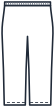
The pant leg is drafted like classic pants: the hip measurement plus ease is divided between the front and back halves; the back has a larger step extension and a slanted center seam; the leg tapers toward the knee and hem. The waist has no darts: the side seam runs vertically, the center front has no slant, so the top of the pants is not narrower than the hip measurement and the pants pull on without a closure. If the belly is wider than the hips, the top is calculated from the belly. A casing is sewn on top — a strip twice the elastic width plus ¾ in2 cm.
How to print and tape
Download the PDF on Letter or A4 sheets and print at 100% scale, without "fit to page." The first sheet has the test square: measure it with a ruler. Tape the sheets with an overlap along the strips ⅜ in1 cm; sheet numbers and the assembly diagram are on the first page. For a copy shop or plotter, choose "One-sheet PDF."
What you get
Full-size front and back pant halves — cut each twice, mirrored; a casing for the elastic; notches at the hip and knee lines, a grainline, seam allowances and hem allowance.
FAQ
What length of elastic should I use?
Usually waist measurement minus 3⅛–3⅞ in8–10 cm — the pattern maker suggests a number under the draft. It's best to try the elastic on: cinch it at the waist so it holds but doesn't dig in. Wide elastic 1⅛–1⅝ in3–4 cm holds better than narrow.
Will the pattern work if my belly is wider than my hips?
Yes. For elastic-waist pants, the pattern maker uses the widest point — hips or belly — so the pants pull on easily and the elastic gathers the top at the waist. For pants with darts, this figure needs a different block, but for elastic waist it works.
How are they different from regular pants?
The leg is the same — with a grainline and tapering toward the knee, like classic pants. The top is different: no darts or zipper, the top is not narrower than the hip measurement, and a casing is sewn on top for the elastic.
What fabric should I choose?
Soft fabrics that gather nicely with elastic: viscose, rayon challis, linen, lightweight cotton, suitings with elastane. Heavy denim and thick wool add bulk at the waist when gathered.