Measurements you need
Tape horizontal around the narrowest part of your torso, usually ¾–1⅝ in above the navel. Snug but not tight; don't pull in your stomach.Tape horizontal around the narrowest part of your torso, usually 2–4 cm above the navel. Snug but not tight; don't pull in your stomach.
Usually 22⅞–43¼ in.Usually 58–110 cm.At the side from the waistline down to the desired hem. For a knee-length skirt — about 23⅝ in, for pants — to the floor or to the ankle bone.At the side from the waistline down to the desired hem. For a knee-length skirt — about 60 cm, for pants — to the floor or to the ankle bone.
Skirt 15¾–39⅜ in, pants 35⅜–43¼ in, shorts 11¾–21⅝ in.Skirt 40–100 cm, pants 90–110 cm, shorts 30–55 cm.Tape horizontal around the fullest part of your buttocks, allowing for the curve of your stomach. Stand straight, feet together.Tape horizontal around the fullest part of your buttocks, allowing for the curve of your stomach. Stand straight, feet together.
Usually 33⅛–51⅛ in.Usually 84–130 cm.How the half-circle skirt is drafted
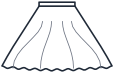
A half-circle skirt is half a ring. The inner half-circle is the waistline, and its length equals your waist plus ease, so the waist radius is that length divided by π. The hem radius is the waist radius plus skirt length, so the length is the same all the way around. The skirt is cut as one piece on the fold or as two halves with side seams.
How much fabric for a half-circle skirt
For a waist of 27½ in70 cm with a waistband, fabric in a single layer, the smaller yardage of the two seam options. For your own measurements, see the "How much fabric" block under the draft.
| Skirt length | Fabric 54 in140 cm | Fabric 60 in150 cm |
|---|---|---|
| 15¾ in40 cm | ⅞ yd0.80 m | ⅞ yd0.80 m |
| 19⅝ in50 cm | 1⅜ yd1.25 m | 1¼ yd1.10 m |
| 23⅝ in60 cm | 1⅝ yd1.40 m | 1⅝ yd1.40 m |
| 27½ in70 cm | 2⅛ yd1.90 m | 1¾ yd1.60 m |
| 31½ in80 cm | 2⅜ yd2.10 m | 2⅜ yd2.10 m |
How to print and tape
Download the PDF on Letter or A4 sheets and print at 100%, without "fit to page". The first sheet has the test square: measure it with a ruler. The circle-skirt piece is large, so you'll get a lot of sheets; for a copy shop or plotter, choose "One-sheet PDF". You can also skip printing: the waist and hem radii are given under the draft, so the circle is easy to draw straight on the fabric with a pin and thread or a tape measure.
What you get
Full-size half-circle pieces with seam allowance and a narrow hem allowance, a waistband or elastic casing, grainline, fabric requirements and a cutting layout.
FAQ
How do I work out the radius for a half-circle skirt?
The waist radius is your waist plus ease, divided by π (about 3.14). With a waist of 27½ in70 cm and ease of ⅜ in1 cm, that's 8⅞ in22.6 cm. The hem radius is the waist radius plus skirt length.
What's the difference between a half-circle and a full-circle skirt?
A full-circle skirt is a complete circle; a half-circle is half of one. The half-circle has less flare, is lighter and needs less fabric: for a 23⅝ in60 cm skirt on 60 in150 cm fabric, about 1⅝ yd1.4 m. You can switch in the "Which skirt do you want" field.
Why should a circle skirt hang before you hem it?
Most of the hem runs on the bias and stretches under its own weight by ⅜–1⅛ in1–3 cm, unevenly around the circle. Baste the skirt, hang it for a day, then put it on and level the hem from the floor — and only then sew the hem.
What hem should a circle skirt have?
A narrow one, ¼–⅜ in0.5–1 cm: a wide hem won't lie flat on a curved edge — its inner edge is shorter than the outer one. The easiest options are a double-fold hem of ¼ in0.5 cm or bias binding.
Waistband or elastic?
With a waistband the skirt sits exactly at the waist and needs a zipper in one of the seams. With elastic, the waistline is calculated from your hip measurement so the skirt pulls on without a fastening — you get soft gathering at the top. Choose the option in the "Fit, ease and seams" field.
One piece or two?
One piece gives a single back seam, but the piece is wide and often has to be cut across the grain. Two pieces give side seams, the pieces lie along the grain, and you need less fabric. The pattern maker calculates the yardage for both options.