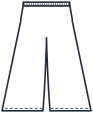
Measurements you need
Tape horizontal around the narrowest part of your torso, usually ¾–1⅝ in above the navel. Snug but not tight; don't pull in your stomach.Tape horizontal around the narrowest part of your torso, usually 2–4 cm above the navel. Snug but not tight; don't pull in your stomach.
Usually 22⅞–43¼ in.Usually 58–110 cm.Tape horizontal around the fullest part of your buttocks, allowing for the curve of your stomach. Stand straight, feet together.Tape horizontal around the fullest part of your buttocks, allowing for the curve of your stomach. Stand straight, feet together.
Usually 33⅛–51⅛ in.Usually 84–130 cm.At the side, from the waistline down to the level where you measured the hip. It helps to tie a ribbon at the waist and measure from it.At the side, from the waistline down to the level where you measured the hip. It helps to tie a ribbon at the waist and measure from it.
Usually 7⅛–8⅝ in.Usually 18–22 cm.Sit on a hard chair. At the side, straight down from the waistline to the seat. This measurement determines whether the pants will pull or hang loose at the crotch.Sit on a hard chair. At the side, straight down from the waistline to the seat. This measurement determines whether the pants will pull or hang loose at the crotch.
Usually 9½–11¾ in.Usually 24–30 cm.At the side from the waistline down to the desired hem. For a knee-length skirt — about 23⅝ in, for pants — to the floor or to the ankle bone.At the side from the waistline down to the desired hem. For a knee-length skirt — about 60 cm, for pants — to the floor or to the ankle bone.
Skirt 15¾–39⅜ in, pants 35⅜–43¼ in, shorts 11¾–21⅝ in.Skirt 40–100 cm, pants 90–110 cm, shorts 30–55 cm.This is not a body measurement but your preference: the circumference of the pant leg at the hem. Slim pants — about 14⅛ in, straight — 17⅜–18⅞ in, wide — 21¼ in and more.This is not a body measurement but your preference: the circumference of the pant leg at the hem. Slim pants — about 36 cm, straight — 44–48 cm, wide — 54 cm and more.
Usually 14⅛–22 in.Usually 36–56 cm.How palazzo pants are drafted
The foundation is the same as for classic trousers: the hip measurement plus ease is divided between the front and back panels, with a larger step extension and a slanted center seam at the back. The rise on palazzo pants is deeper by ⅜ in1 cm so the trousers sit loosely. Below the hip line, the side seam and inseam run straight to the hem at the chosen width, without tapering to the knee; the side seam length equals the length measurement, and the back inseam is ¼–⅜ in0.5–1 cm shorter than the front — it is slightly stretched when sewn.
Which fabric to choose
Palazzo pants hold their shape well in linen, cotton-viscose blends, and suiting fabrics; they drape beautifully in viscose, crepe, spun rayon, and silk. The softer the fabric, the wider you can make the leg. For patterned fabric, keep in mind that the legs are wide: each panel takes up almost the full width of the fabric.
How to print and tape
Download the PDF on Letter or A4 sheets and print at 100% scale, without "fit to page." The first sheet has the test square: measure it with a ruler. The sheets are taped together with an overlap along the strips ⅜ in1 cm; sheet numbers and the assembly diagram are on the first page. For a copy shop or plotter, choose "One-sheet PDF."
What you get
Full-size front and back palazzo panels — each cut twice, mirrored; an elastic casing or a waistband with extra for a closure; notches at the hip line, grainline, seam allowances, and hem allowance.
FAQ
What leg width should I choose for palazzo pants?
This is the circumference of one leg at the hem. Around 27½ in70 cm gives moderately wide trousers, 90–110 is classic palazzo, and 130 and up is very wide, almost skirt-like. For soft, drapey fabrics you can go wider; for crisp fabrics, narrower.
Elastic or waistband?
With elastic, palazzo pants pull on without a closure: the top is cut to the hip measurement, and the elastic gathers it at the waist. With a waistband, the trousers fit exactly at the waist, with darts and a zipper in the side or center seam. Choose the option in the "How it sits at the waist" field.
What length of elastic should I use?
Usually waist measurement minus 3⅛–3⅞ in8–10 cm — the pattern maker suggests a number under the draft. It's best to try the elastic on: stretch it around your waist so it holds but doesn't dig in.
How are palazzo pants different from regular trousers?
Up to the rise line it's the same foundation, just a slightly deeper rise — the trousers are looser. Below that, the leg doesn't taper to the knee but flares straight to a wide hem. The hem is curved so that after sewing the seams, the hem allowance lies flat.