Measurements you need
Tape horizontal around the narrowest part of your torso, usually ¾–1⅝ in above the navel. Snug but not tight; don't pull in your stomach.Tape horizontal around the narrowest part of your torso, usually 2–4 cm above the navel. Snug but not tight; don't pull in your stomach.
Usually 22⅞–43¼ in.Usually 58–110 cm.Tape horizontal around the fullest part of your buttocks, allowing for the curve of your stomach. Stand straight, feet together.Tape horizontal around the fullest part of your buttocks, allowing for the curve of your stomach. Stand straight, feet together.
Usually 33⅛–51⅛ in.Usually 84–130 cm.At the side, from the waistline down to the level where you measured the hip. It helps to tie a ribbon at the waist and measure from it.At the side, from the waistline down to the level where you measured the hip. It helps to tie a ribbon at the waist and measure from it.
Usually 7⅛–8⅝ in.Usually 18–22 cm.At the side from the waistline down to the desired hem. For a knee-length skirt — about 23⅝ in, for pants — to the floor or to the ankle bone.At the side from the waistline down to the desired hem. For a knee-length skirt — about 60 cm, for pants — to the floor or to the ankle bone.
Skirt 15¾–39⅜ in, pants 35⅜–43¼ in, shorts 11¾–21⅝ in.Skirt 40–100 cm, pants 90–110 cm, shorts 30–55 cm.This is not a body measurement but a style choice: from the side waist down to where the skirt starts to flare into a bell. Leave 0 — the pattern maker will take a point just above the knee.This is not a body measurement but a style choice: from the side waist down to where the skirt starts to flare into a bell. Leave 0 — the pattern maker will take a point just above the knee.
Usually 17¾–23⅝ in.Usually 45–60 cm.How the godet skirt is drafted
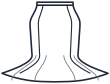
All panels are identical. The panel width at the waist is the waist with ease divided by the number of panels; at the hip it's the hip with ease divided the same way. There are no darts: the difference between hip and waist goes equally into the seams. Below the hip the panel narrows slightly before the flare begins, then the seam curves smoothly outward. The hem is an arc that meets the seams at a right angle, so after sewing it lies flat; the waist also meets the seams at a right angle. The length at the center of the panel equals the skirt length.
The pattern maker checks the draft itself: waist and hip circumferences along the finished outline, length at the center of the panel, right angles at the hem and waist, and smoothness of the seam. Results appear in the "Draft check" section.
How to sew
Cut all panels on the grainline — the arrow at the center of the panel. Baste the panels together, matching the notches at the hip line and at the start of the flare, and leave an opening for the zipper in one seam. The bell-shaped hem is turned up narrowly, ¼–⅜ in0.5–1 cm; let the skirt hang for a day before hemming — the bias areas of the panels will stretch.
How to print and tape
Download the PDF on Letter or A4 sheets and print at 100% scale, without "fit to page." The first sheet has the test square: measure it with a ruler. Sheets are taped with an overlap along the ⅜ in1 cm strips; sheet numbers and the assembly diagram are on the first page. For a copy shop or plotter, choose "One-sheet PDF."
What you get
A full-size skirt panel — cut it as many times as there are panels; a waistband with extra length for the closure. Notches at the hip line and at the start of the flare, grainline, seam allowances, and a narrow hem allowance.
FAQ
How many panels should I choose?
Six — a classic godet skirt. Eight panels give a fuller, more even bell and work better when there's a big difference between hip and waist. Four is easier to sew, but the bell is more modest: a wide panel can't flare very much.
How do I choose the flare?
The flare is how much wider the hem of the panel is at each seam than at the start of the flare. If you leave it at 0, the pattern maker will choose a full bell that the panel width allows (up to 3⅞ in10 cm). If you enter more than fits, the pattern maker will state the largest possible number.
Where does the flare start?
Usually just above the knee — the pattern maker calculates this spot itself. The higher the start, the sooner the skirt flares and the fuller you can make it; the lower, the more pronounced the mermaid silhouette.
Where do I insert the zipper?
In any seam between panels — usually the one at the left side or center back. The waistband is drafted with extra length 1⅛ in3 cm for the closure.